
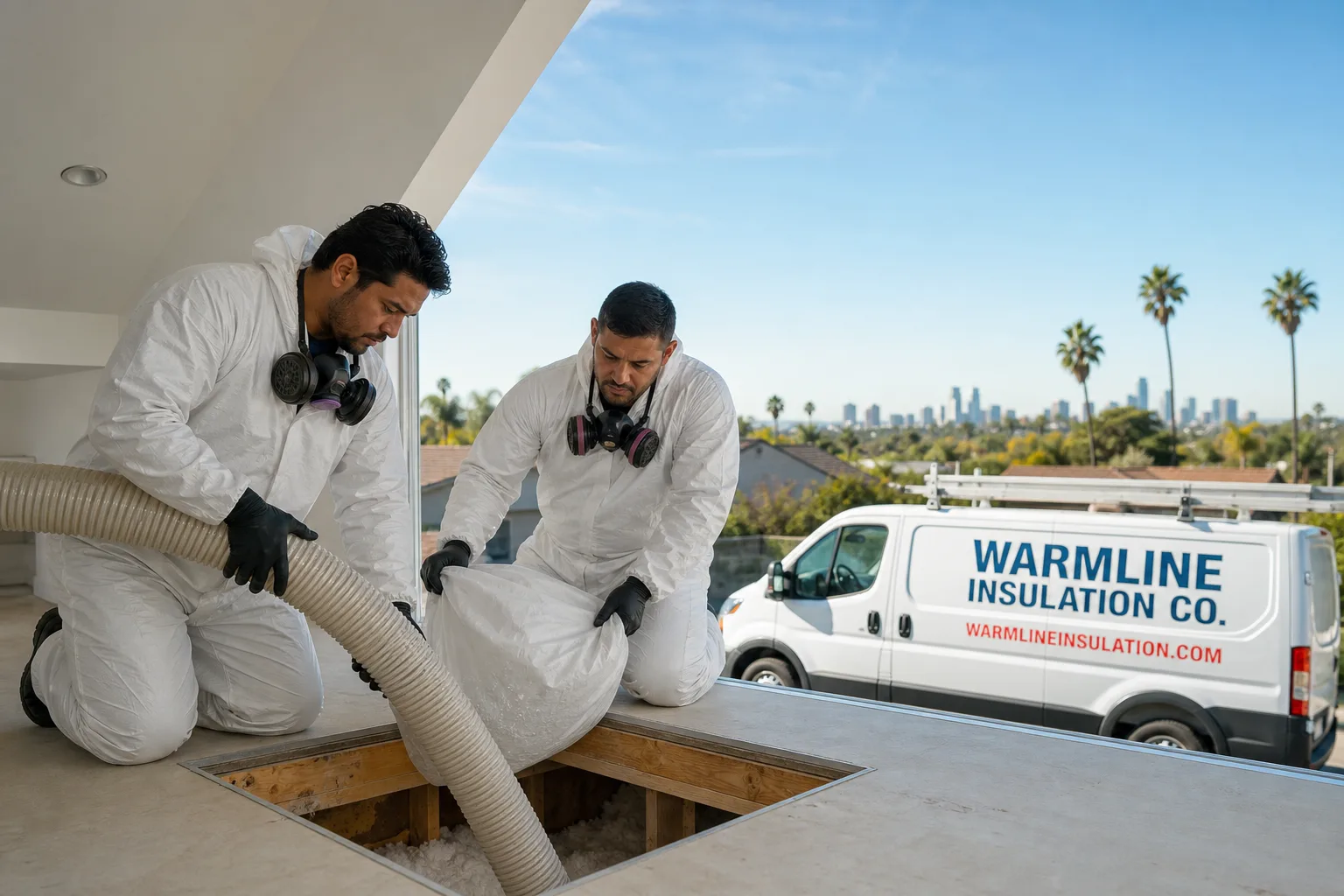
How Much Does Attic Insulation Cost in Los Angeles?
Our Attic Insulation services in Los Angeles typically cost between $1,500 and $4,200 for a standard single-family home, with most homeowners paying around $2,400 to $3,000 for a full attic insulation job using blown-in fiberglass or cellulose. The exact price depends on your attic’s square footage, current insulation condition, the material you choose, and whether air sealing is done at the same time – which it almost always should be in LA’s older housing stock.
Attic Insulation Cost Breakdown (2026)
Here’s how the numbers break down across the most common insulation types and project scopes for Attic Insulation Near Me in Los Angeles, CA. These ranges reflect real jobs we complete in neighborhoods like Silver Lake, Reseda, Torrance, Pasadena, and Van Nuys – not national averages that often miss the Southern California labor market.
| Service / Material | Typical Cost Range (Los Angeles, 2026) |
|---|---|
| Blown-In Fiberglass (1,000-1,500 sq ft attic) | $1,200 - $2,200 |
| Blown-In Cellulose (1,000-1,500 sq ft attic) | $1,100 - $2,000 |
| Blown-In Fiberglass or Cellulose (1,500-2,500 sq ft attic) | $2,000 - $3,800 |
| Fiberglass Batt Installation | $1,400 - $2,800 |
| Spray Foam (open-cell, per 1,000 sq ft) | $1,800 - $3,200 |
| Spray Foam (closed-cell, per 1,000 sq ft) | $3,000 - $5,500 |
| Radiant Barrier Installation | $800 - $1,800 |
| Attic Air Sealing Only | $500 - $1,200 |
| Old Insulation Removal + Disposal | $600 - $1,500 |
| Attic Air Sealing + Blown-In Insulation (combined) | $2,200 - $4,200 |
| Full Attic Package (removal, air seal, new insulation) | $3,000 - $5,500 |
| Attic Cleaning & Rodent Proofing (add-on) | $400 - $1,200 |
A few things push costs toward the higher end of those ranges in Los Angeles specifically. Labor rates here run about 15 to 20 percent above the national median, and many homes in the Valley and older Westside neighborhoods have difficult attic access – low clearance, multiple HVAC systems up there, or decades of compacted, contaminated insulation that has to come out first. When we quote a job, the price is always upfront before a single bag of material gets loaded.
If you’re comparing quotes, one thing to watch for: some contractors price attic insulation without including air sealing. In Los Angeles, where we have significant temperature swings between daytime and nighttime, skipping air sealing means you’re leaving most of the energy savings on the table. The insulation slows heat transfer; the air sealing stops conditioned air from leaking out entirely. They work together, and a quote that separates them often ends up costing more when you circle back to fix what was left undone.
What Affects Attic Insulation Pricing in Los Angeles
- Attic size and accessibility. This is the biggest single variable. A 900-square-foot attic in a Sherman Oaks bungalow with good access costs meaningfully less to insulate than a 2,000-square-foot attic in a Northridge split-level where our technicians are navigating low rafters and multiple HVAC ducts. Every estimate starts with a physical measurement, not an assumption.
- Existing insulation condition. Homes built before 1980 in Los Angeles often have original fiberglass batts that have compressed, settled, or absorbed moisture from bathroom exhaust that was improperly vented into the attic cavity. Contaminated or rodent-damaged insulation has to come out before new material goes in, and that removal adds $600 to $1,500 depending on volume and contamination level.
- Material choice. Blown-in cellulose from GreenFiber is typically the most cost-effective option for attic floors, while Icynene open-cell spray foam is popular for unvented, conditioned attic applications. Closed-cell spray foam from Demilec costs more per square foot but delivers a superior air and moisture barrier – useful in homes near the coast or in neighborhoods with marine layer issues like El Segundo or Culver City. Johns Manville and Owens Corning fiberglass batts split the difference in price and performance.
- Target R-value. California’s Title 24 energy code currently requires R-38 in climate zone 9 (which covers most of the LA basin) and R-49 in hotter inland zones like the eastern San Gabriel Valley. Getting from zero to R-38 costs less than getting from zero to R-49, and going from existing R-11 to R-38 is less work than a full removal-and-replacement job. We always confirm your home’s climate zone during the estimate so the final R-value is code-compliant.
- Air sealing scope. A few penetrations around recessed lights and plumbing chases might add $500 to the job. An attic with 30 to 40 unsealed bypasses – common in 1960s tract homes throughout the San Fernando Valley – can push air sealing costs to $1,200 or more. It’s worth it: those bypasses are often responsible for more heat loss than the missing insulation itself.
- Add-on services. Attic cleaning, rodent proofing, and radiant barrier installation are frequently combined with insulation projects in Los Angeles, particularly in the Valley where summer attic temperatures can exceed 150 degrees Fahrenheit and roof rats are a persistent issue in areas like Encino and Granada Hills. Bundling these services under one contractor – which is how we work at Warmline – typically saves money compared to scheduling multiple trades.
Los Angeles-Specific Factors That Change the Math
Most national pricing guides are built around Midwestern or Southeastern housing stock, and they don’t account for some things that are specific to Los Angeles homes and climate.
Title 24 compliance. California’s Title 24 energy standards apply to insulation replacements in existing homes when the project hits certain thresholds. In practice, this means the R-value we install has to meet code minimums for your specific climate zone – and in Los Angeles, that’s not always the same number. Homes in Malibu sit in a different climate zone than homes in Azusa. We pull the correct zone data for every job and make sure the finished project is compliant. Some contractors skip this step and leave homeowners with non-compliant work that creates problems at resale.
Utility rebates. Los Angeles Department of Water and Power (LADWP) and Southern California Gas Company both offer rebates for attic insulation upgrades that meet specific R-value and installation requirements. These rebates can offset $200 to $500 of project cost, sometimes more depending on the current program cycle. We walk customers through what’s currently available during the estimate – the programs change periodically, so we check current eligibility rather than quoting stale numbers.
Radiant heat load. In the San Fernando Valley and in hillside neighborhoods like Mount Washington and Eagle Rock, attic temperatures in July and August are brutal. Standard blown-in insulation handles conductive and convective heat gain well, but radiant heat coming off a hot tile or composition roof calls for a radiant barrier in addition to mass insulation. In Valley homes especially, we regularly recommend pairing Owens Corning blown-in with a foil radiant barrier for maximum summer comfort. It adds $800 to $1,400 to the project but can reduce cooling costs enough to pay back within two to three summers.
Older housing stock. A significant portion of Los Angeles homes were built between 1945 and 1975, before energy codes required any attic insulation at all. We work in these homes constantly – in neighborhoods like Leimert Park, Boyle Heights, and Mid-City. Many have original blown-in mineral wool or compressed fiberglass that’s doing almost nothing thermally. The removal and replacement process is more involved than a simple top-up, but the performance improvement is dramatic.
How to Save on Attic Insulation in Los Angeles
Start with a home energy audit. Before spending money on insulation, a home energy audit identifies exactly where your home is losing conditioned air and heat. It prevents the common mistake of adding insulation to an attic that still has major bypass leaks, or insulating when a different system (duct sealing, for example) would deliver more savings per dollar. Our home energy audit is the diagnostic starting point that makes every service we provide more targeted and cost-effective. Call (855) 657-3403 to schedule yours – we’ll tell you exactly what your home needs before quoting anything.
Combine services in one visit. Air sealing, insulation, and radiant barrier installation can almost always be done in a single visit. Scheduling them separately means paying for separate mobilization, and you’ll often pay more per service when they’re split up. Most of our Los Angeles jobs are completed in one day, which also means less disruption to your household.
Check for utility rebates before you commit to a scope. LADWP and SoCalGas rebates are real money, but they have specific requirements – including minimum R-values, installation documentation, and sometimes pre-approval. Call us first and we’ll tell you whether your planned project qualifies. A small change in scope can sometimes unlock a larger rebate.
Ask about our standing discounts. We offer $50 off any repair over $250 and a permanent 5% discount for seniors and veterans. If your project falls near a shoulder season (late fall or early spring in Los Angeles), scheduling is often faster and you’re less likely to wait. We’re also happy to walk you through our $89 Seasonal Tune-Up if you want a lower-cost entry point to assess your attic before committing to a full project.
Don’t defer if you have existing damage. Old, contaminated, or rodent-damaged insulation continues to degrade the longer it sits. In some Valley neighborhoods, roof rat activity in late fall is a near-annual problem. Leaving compromised insulation in place doesn’t save money – it usually means a more expensive job later, plus potential duct contamination or structural moisture issues. An honest assessment of what you actually need is always the starting point. Call (855) 657-3403 and a live person will pick up – no voicemail, no callback queue.
Attic Insulation R-Value Requirements in Los Angeles
California’s Title 24 standards divide Los Angeles County into several climate zones. Here’s a simplified breakdown of the minimum R-values that apply to most insulation replacements and new installations in the area:
- Climate Zone 6 (coastal areas: Santa Monica, El Segundo, Playa del Rey, Long Beach coastal): R-38 minimum for attic floors
- Climate Zone 9 (most of the LA basin and inner suburbs: Culver City, Torrance, Burbank, Glendale, Pasadena, most of the Valley): R-38 minimum
- Climate Zone 10 (hotter inland areas: eastern San Gabriel Valley, Pomona, West Covina, Azusa): R-49 minimum
These are floor requirements, not performance targets. Many building science professionals – and we agree – recommend R-49 across most of the LA basin when replacing insulation entirely, because the marginal cost of going from R-38 to R-49 is small relative to the total project cost, and the comfort improvement over a 10 to 15 year horizon is meaningful. We’ll always give you the honest recommendation, not just the minimum.
Blown-In vs. Spray Foam vs. Batts: Which Is Right for Your LA Home?
Blown-In Insulation (Fiberglass or Cellulose)
This is the most common choice for attic floors in Los Angeles and the right one for most homes. Blown-in fiberglass (Owens Corning or Knauf) and blown-in cellulose (GreenFiber) both conform to irregular joist spaces and settle around obstructions. Cellulose has a slightly higher recycled content and performs marginally better in the noise-reduction department. Fiberglass is more moisture-resistant, which matters in homes near the coast. Either way, blown-in is fast to install, cost-effective, and gets to R-38 or R-49 reliably. Most single-day attic jobs in Los Angeles use blown-in material.
Spray Foam
Spray foam – particularly open-cell spray foam from Icynene or Demilec – makes sense when you’re insulating a sloped roofline rather than an attic floor, or when you want to bring the attic into conditioned space (common for homes with HVAC equipment up there). It’s also the best option for irregular or complex attic geometries. Open-cell foam runs $1.80 to $3.20 per square foot installed; closed-cell is $3.00 to $5.50. It’s not overkill for every situation, but it’s genuinely the right tool for certain applications – and we’ll tell you honestly if your attic is one of them.
Fiberglass Batts
Owens Corning and CertainTeed fiberglass batts work well in attics with standard joist spacing and clean existing conditions. They’re slightly less effective than blown-in at conforming to irregular spaces, and installation quality matters more – a batt that’s compressed or has gaps loses significant R-value. When batts are the right call, we install them to manufacturer specs, which isn’t always how they show up in older homes.
Rockwool (Mineral Wool) Batts
Rockwool batts have excellent fire resistance and noise-reduction properties, and they hold their R-value better than standard fiberglass when compressed. They cost about 15 to 20 percent more than equivalent fiberglass batts. In multi-unit buildings or homes near LAX flight paths, the acoustic benefit is a real differentiator.
What to Expect From the Warmline Process
We’ve been doing this in Los Angeles since 2011, and Neil Ashford built Warmline on a pretty simple premise: homeowners deserve to know exactly what’s going in their attic, why, and what it will cost before anyone picks up a tool. Here’s how a typical job goes.
First, we do a thorough attic inspection – not a five-minute walk-through, but a real look at existing insulation depth and condition, air sealing status, duct condition if applicable, ventilation, and any signs of pest activity or moisture. If there’s existing insulation that needs to come out, we scope that clearly and price it separately so you can see exactly what you’re paying for.
Then we give you an upfront quote. No “we’ll figure it out when we start.” The price you agree to is the price you pay.
For most Los Angeles attic jobs, we’re in and out in a single day. Our technicians are background-checked, uniformed, and working with the same brands – Owens Corning, Rockwool, GreenFiber, Icynene, Demilec, CertainTeed, Johns Manville, Knauf – that building scientists and energy auditors actually recommend. We don’t sub out to whoever’s available. The people who show up are our people.
And everything we do is backed by our 90-Day Done Right Promise. If something isn’t right within 90 days of the job, we come back and fix it. That’s a written commitment, not a verbal one – and it’s something most insulation contractors in Los Angeles simply don’t offer.
You can learn more about our full scope of work on our Attic Insulation in Los Angeles service page, or visit our home to see everything we offer under one roof.
FAQs – Attic Insulation Cost in Los Angeles
How much does attic insulation cost in Los Angeles?
Most attic insulation jobs in Los Angeles run between $1,500 and $4,200 for a standard single-family home, with the middle of that range – around $2,400 to $3,000 – covering a full blown-in installation with basic air sealing for a 1,200 to 1,800 square foot attic. Larger attics, difficult access, old insulation removal, or premium materials like spray foam push the price higher. Call (855) 657-3403 for a free, no-obligation estimate – a live person answers every call.
Is it cheaper to add insulation on top of existing insulation or remove and replace?
Adding on top is cheaper in the short term – typically $1,100 to $2,200 for a top-up versus $2,500 to $5,000 for full removal and replacement. But it’s only appropriate if the existing insulation is clean, dry, free of pest contamination, and properly covering the attic floor. In Los Angeles, where we frequently find compressed, rodent-damaged, or asbestos-era insulation in homes from the 1950s through 1970s, removal and replacement is often the only real option. We’ll tell you honestly which situation your attic is in – we don’t recommend removal just to run up the bill. Call (855) 657-3403 to get a straight answer.
Can you insulate my attic in one day?
Yes – most Los Angeles attic insulation jobs are completed in a single visit. A standard blown-in job on a 1,000 to 1,800 square foot attic typically takes four to six hours including setup, air sealing, and cleanup. Larger projects, combined removal and replacement jobs, or homes with complex attic geometry may run into a second day, but that’s the exception rather than the rule. We’ll give you a realistic time estimate before we schedule.
Does attic insulation actually lower my energy bills in Los Angeles?
Yes, meaningfully so – especially in San Fernando Valley homes where summer cooling is the dominant energy cost. Properly air-sealed and insulated attics typically reduce HVAC energy consumption by 15 to 25 percent compared to uninsulated or under-insulated attics, according to EPA and Department of Energy data. In Los Angeles, where July and August attic temperatures can exceed 150 degrees Fahrenheit, the cooling load reduction is real. Homes in Reseda, Chatsworth, and Van Nuys – where we work regularly – often see the most dramatic improvement because the heat load there is so high.
What R-value does my Los Angeles home need?
R-38 is the California Title 24 minimum for most of the Los Angeles basin (climate zones 6 and 9), and R-49 applies to hotter inland zones like the eastern San Gabriel Valley. That said, we recommend R-49 for most whole-attic replacement projects throughout the LA area regardless of minimum requirement, because the incremental cost to get there is small and the long-term benefit is real. We’ll confirm your home’s exact climate zone during the estimate so you know the finished job is code-compliant.
Does Warmline Insulation Co. offer financing or discounts?
We have three standing offers that apply to Los Angeles customers: $50 off any repair over $250, an $89 Seasonal Tune-Up, and a permanent 5% discount for seniors and veterans. For larger projects, ask about payment options when you call – we’re straightforward about what’s available. We don’t invent discounts on the fly, and we don’t inflate prices just to cut them. Upfront pricing means the number we quote is the number you pay. Call (855) 657-3403 for your free estimate.
Ready to Get an Accurate Quote for Your Los Angeles Home?
Neil Ashford and the Warmline team have been insulating Los Angeles homes since 2011 – from aging bungalows in Leimert Park to Valley ranch homes in Northridge to craftsman houses in Pasadena. We know what Los Angeles attics look like, what they need, and what it costs to do the job right. Every estimate is free, every price is upfront, and every job is backed by our 90-Day Done Right Promise.
Call (855) 657-3403 now – a live person picks up every time, around the clock. We’ll schedule your free attic inspection, walk you through exactly what we find, and give you a written quote before any work begins. Most jobs are done in a single visit. No runaround, no surprises.
Pricing reflects the Los Angeles market as of 2026. Warmline Insulation Co. offers free estimates – call (855) 657-3403.
Written by Neil Ashford, Owner at Warmline Insulation Co., serving Los Angeles, CA since 2011.
What Our Customers Say
"Crawl space smelled musty and the floors were cold. Full encapsulation with the thick liner taped at every seam, and a dehumidifier sized for the space. The hygrometer they left reads 48 percent now instead of the 70s."
- Elena Vasquez"The estimate had every line itemized - removal, sealing, baffles, the blown-in by the bag - and the final invoice matched it exactly. Two other companies quoted a single number and could not tell me what R-value they were installing."
- Priya Raman"Radiant barrier stapled to the rafters plus new baffles at the soffits. Attic temperature dropped enough that the AC runs noticeably less in the afternoon. Crew was in and out in a day and left the garage cleaner than they found it."
- Sam Kessler