
Insulation in Chicago, IL
Crawl space encapsulation and vapor barrier work in Chicago usually runs $3.50-$7.50 per square foot, but the real cost driver here isn’t the liner, it’s what’s happening inside the crawl space: 100-year-old brick foundations, damp clay soil, and freeze-thaw cycles that force water through the walls every winter. Chicago’s housing stock is older and heavier than almost any other U.S. metro, which means the fix is rarely a simple sheet of poly. Whether you’re in a bungalow in Portage Park or a two-flat in Bridgeport, the job starts with knowing exactly what your foundation is doing. Call (855) 657-3403 and you’ll get a live person who can schedule the diagnosis.
Why Chicago Homes Are Different
Chicago sits in IECC Climate Zone 5A, which sounds technical but means something very concrete: polar vortex events regularly push overnight lows to -10°F to -20°F, and that’s the actual temperature, not wind chill. When it drops that low, a thermal bridge through an uninsulated brick wall or a poorly detailed rim joist produces the kind of heat loss that shows up in a $600 ComEd bill. Wind off Lake Michigan compounds it, especially on the east- and north-facing exposures of buildings in Rogers Park, Edgewater, and Hyde Park, where infiltration pressure finds every gap in the envelope.
The housing stock compounds the climate. Chicago’s dominant residential forms, the Chicago bungalow, the brick two-flat, and the greystone three-flat, were mostly built between 1890 and 1950. They’re masonry-clad with original plaster-on-lath interiors, and many have either no wall cavity or a cavity so narrow that drill-and-fill blown insulation is impractical. Balloon-framed two-flats from this era often have open wall cavities running floor-to-ceiling, which creates fire-stop and air-sealing requirements that have to be addressed alongside any insulation work. The bungalow belt on the Northwest and Southwest sides, tens of thousands of solid-brick 1.5-story homes built between roughly 1910 and 1940, presents a particular challenge: double-wythe solid masonry walls with no stud cavity at all. Contractors here have to master interior rigid foam board against brick or exterior continuous insulation strategies that are rarely needed in neighboring Midwestern cities with younger, wood-framed housing stock.
Our Main Chicago Services
Two services dominate Chicago insulation calls: attic insulation, because bungalow attics routinely hold 1-to-2 inches of original vermiculite that tests positive for asbestos, and crawl space encapsulation, because damp brick foundations are endemic here. Here’s what each involves.
Attic Insulation in Chicago
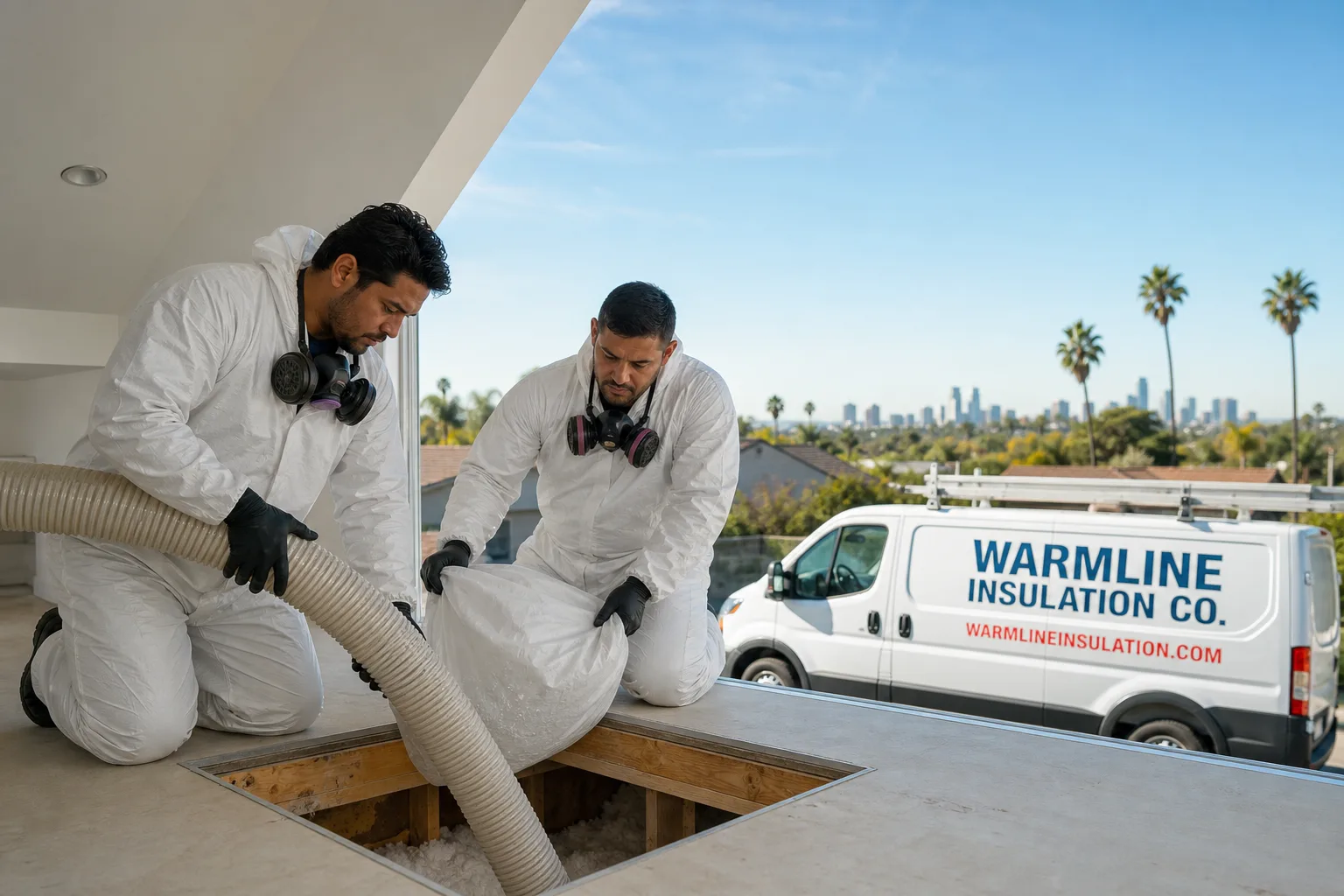
In nearly every Chicago bungalow attic we open, the original material is 1-to-2 inches of vermiculite or early fiberglass bat, often asbestos-positive and always far below the modern R-49 code target. The job starts with a hazmat assessment before any new blown cellulose or open-cell spray foam goes in. After removal, we air seal the attic floor and blow to R-49 minimum. For the full scope, see Attic Insulation in Chicago. Most attics are done in a single visit, and the 90-Day Done Right Promise covers every inch.
What happens when you call
- 1
A real person answersNo phone trees - you reach a local pro.
- 2
You get an upfront price rangeHonest numbers before anyone is dispatched.
- 3
A background-checked tech heads outLicensed & insured, dispatched right away.
- 4
You approve before work beginsNothing starts until you say go.
Crawl Space Encapsulation & Vapor Barrier in Chicago
Most Chicago homes with crawl spaces are working against a foundation built before modern damp-proofing existed. The brick or stone walls sit directly against Chicago’s clay-heavy soil, and every freeze-thaw cycle in winter pushes moisture through the masonry, so what homeowners experience as a “musty basement smell” is actually a year-round moisture pump. A properly installed vapor barrier and encapsulation system stops that pump: it seals the floor and walls, controls humidity, and keeps the air in your home from carrying damp, mold-laden crawl space air up into the living space. We install Crawl Space Encapsulation & Vapor Barrier systems with 10-to-20-mil reinforced liner and sealed seams, and every job is backed by our 90-Day Done Right Promise.
Crawl Space Vapor Barrier
Signs you need it
Damp crawl space air, condensation on ductwork or floor joists, and that musty smell that rises into the first floor are the three most common signals in Chicago. If your crawl space floor is bare dirt, you need a vapor barrier, period.
What it costs in Chicago
Expect $2.25-$5.00 per square foot for a 6-to-12-mil vapor barrier over a dirt crawl space floor, depending on how much prep the floor needs.
How we do it
We clear and level the floor, lay the poly with 6-to-12-inch seams sealed and taped, run it up the foundation walls, and fasten it at the sill. Every seam gets inspected before we call the job done.
Crawl Space Encapsulation
Signs you need it
Standing water after rain, visible efflorescence on brick walls, or insulation falling from between the floor joists means the crawl space needs more than a floor liner. Encapsulation seals the whole envelope.
What it costs in Chicago
Full encapsulation in Chicago typically runs $3.50-$7.50 per square foot, which includes floor liner, wall coverage, and sealing of vents and rim joist penetrations.
How we do it
We clean and treat the space, install the liner on floor and walls, seal vents and all penetrations, and add a dehumidifier where the moisture load demands it. Most Chicago crawl spaces are encapsulated in one to two days.
What Crawl Space Encapsulation & Vapor Barrier Costs in Chicago
| Item | Typical range in Chicago |
|---|---|
| Crawl Space Vapor Barrier | $2.25-$5.00 per sq ft |
| Crawl Space Encapsulation | $3.50-$7.50 per sq ft |
| Battery Backup Sump Pump | $850-$2,850 installed |
| Crawl Space French Drain | $60-$90 per linear ft |
Costs in Chicago move with foundation age and access. A tight crawl space under a 1920s bungalow takes longer than an open one under a suburban split-level, and wet clay soil means more dehumidification. We give upfront pricing before any work starts, and the quote is the price.
Is crawl space encapsulation worth it in Chicago’s climate?
Yes, and more than in most cities. Chicago’s freeze-thaw cycles and clay soil push moisture through brick foundations all winter, and that damp air rises into your living space year-round. Encapsulation stops the moisture at the source and protects floors, joists, and air quality.
Can you encapsulate a crawl space with a dirt floor in Chicago?
Yes. Any Chicago crawl space with bare dirt should have at minimum a vapor barrier, and full encapsulation is the better long-term fix. We level the floor, lay reinforced liner, seal walls and vents, and add dehumidification if needed. Call (855) 657-3403 for a free estimate.
Spray Foam Insulation in Chicago
Spray foam earns its cost in Chicago because our winters punish every air gap. Closed-cell foam in particular acts as both insulation and air seal, which matters enormously in a city where wind off Lake Michigan forces cold air through brick walls and rim joists from November through March. We install Spray Foam Insulation from Icynene and Demilec, and the 90-Day Done Right Promise covers the whole job.
Open-Cell Spray Foam
Signs you need it
An attic that can’t hold heat, upstairs rooms that stay cold in January, or airflow noise from vent openings all point to open-cell foam as the right air-sealing and insulating fix.
What it costs in Chicago
Open-cell spray foam in Chicago runs $0.50-$1.50 per board foot, so a typical bungalow attic at R-49 lands between roughly $2,500 and $5,000.
How we do it
We seal the space, apply open-cell foam to the attic floor or roofline, and check depth against R-49. It cures in a few hours and air sealing is built into the application.
Closed-Cell Spray Foam
Signs you need it
Rim joists that frost over, moisture on foundation walls, or rooms above a garage that never warm up signal closed-cell foam, which adds structural strength and acts as a vapor retarder.
What it costs in Chicago
Closed-cell spray foam in Chicago typically costs $1.00-$2.50 per board foot, with rim joist work usually falling between $1,200 and $3,500 for a standard two-flat.
How we do it
We apply closed-cell foam to rim joists, crawl space walls, or rooflines in 2-to-3-inch lifts, and it cures dense and rigid. This is the right product where moisture control and air sealing have to happen together.
What Spray Foam Insulation Costs in Chicago
| Item | Typical range in Chicago |
|---|---|
| Open-Cell Spray Foam | $0.50-$1.50 per board ft |
| Closed-Cell Spray Foam | $1.00-$2.50 per board ft |
| Rim Joist Spray Foam | $3-$7 per linear ft |
| Spray Foam Roof Deck | $4-$8 per sq ft |
What pushes spray foam cost up in Chicago is access: bungalow attics with steep pitches and tight clearances take more time than open attic floors. We quote the job after a site check, and that quote doesn’t change at the end of the day.
Is spray foam safe in brick Chicago bungalows?
Closed-cell foam works well against interior brick walls where a stud cavity doesn’t exist, because it insulates and air seals in one pass. The foam cures inert and we ventilate the space during application. It’s a standard retrofit for solid masonry walls in Chicago.
How long does spray foam last in Chicago’s climate?
Spray foam is a 20-to-30-year product when applied correctly, and Chicago’s freeze-thaw cycles don’t degrade it the way they degrade fiberglass batts. The key is the install: proper depth, no gaps, correct substrate prep. Our 90-Day Done Right Promise covers every application.
Blown-In Insulation in Chicago
Blown-in insulation is the workhorse of Chicago attic retrofits, because it fills the irregular joist bays of 1910-1940 bungalows better than any batt ever will. Most Chicago attics we see hold 1-to-2 inches of original material and need a full top-up to R-49. We install Blown-In Insulation using Knauf and GreenFiber products, and most jobs finish in a single visit.
Blown-In Cellulose
Signs you need it
An attic floor with thin or settled material, ice dams after snow, or rooms that lose heat fast after the furnace shuts off call for blown-in cellulose.
What it costs in Chicago
Blown-in cellulose in Chicago runs $1.00-$2.50 per square foot installed to R-49, so the average bungalow attic lands between $1,500 and $3,800.
How we do it
We dense-pack or loose-fill cellulose to R-49, build depth markers, and blow around all penetrations. The material settles predictably and we account for settlement in the depth.
Blown-In Fiberglass
Signs you need it
Lighter material desired, better resistance to moisture than cellulose, or an attic with existing fiberglass that just needs a top-up are all good fits.
What it costs in Chicago
Blown-in fiberglass in Chicago costs $1.25-$2.75 per square foot installed to R-49, running a little higher per square foot than cellulose but lighter per R-value.
How we do it
We blow fiberglass to the target depth, check for even coverage, and avoid compressing the existing layer. It’s fast, clean, and most attics are done in under a day.
What Blown-In Insulation Costs in Chicago
| Item | Typical range in Chicago |
|---|---|
| Blown-In Cellulose | $1.00-$2.50 per sq ft |
| Blown-In Fiberglass | $1.25-$2.75 per sq ft |
| Dense-Pack Wall Insulation | $2.50-$6.50 per sq ft |
| Blown-In Top-Up | $0.80-$2.00 per sq ft |
The cost variable in Chicago is attic access and whether removal is needed first. If the original vermiculite tests positive for asbestos, removal is a separate line item before any new blown material goes in. We’ll tell you exactly what’s needed before we start.
Do I need to remove old insulation before blowing in new material in Chicago?
Not unless the old material is contaminated, water-damaged, or asbestos-positive. Many Chicago bungalows have vermiculite that requires testing and removal first. If the old material is clean fiberglass, we can often blow right over it. Call (855) 657-3403 for a site check.
How deep should blown-in insulation be in a Chicago attic?
R-49 is the Department of Energy target for Climate Zone 5A, which is roughly 14 to 18 inches of blown cellulose or fiberglass depending on the product. Most Chicago attics we see have about 2 inches. We build depth markers so you can see the R-value we installed.
Radiant Barrier Installation in Chicago
Radiant barrier earns its keep in Chicago during July and August, when top-floor rooms in brick bungalows and two-flats bake under the sun. The issue is radiant heat gain through the roof deck, and a foil radiant barrier reflects that heat back out before it reaches your living space. We install Radiant Barrier Installation as a single-visit job, and the 90-Day Done Right Promise applies.
Attic Radiant Barrier
Signs you need it
Upstairs rooms that run 10 to 15 degrees hotter than the rest of the house in summer, or an air conditioner that can’t keep up on July afternoons, are classic radiant heat gain problems.
What it costs in Chicago
Attic radiant barrier in Chicago runs $1.00-$2.50 per square foot installed, so a typical 1,200-square-foot bungalow attic lands between $1,200 and $3,000.
How we do it
We staple the foil to the underside of the roof rafters, leaving the required air gap for heat reflection, and keep attic ventilation paths clear. Full installs usually finish in one day.
Radiant Barrier Roof Deck
Signs you need it
New roof going on, or an attic with no existing barrier and a south- or west-facing exposure that gets full Chicago summer sun, is the ideal moment for a roof-deck radiant barrier.
What it costs in Chicago
Radiant barrier roof deck installation in Chicago typically costs $1.50-$3.50 per square foot, depending on roof pitch and whether it’s part of a reroof or a retrofit.
How we do it
We lay the foil over the roof deck before the shingles go on, which is the highest-performance placement. On retrofit jobs we work from inside the attic instead. Both are valid; the roof-deck route is just better when timing allows.
What Radiant Barrier Installation Costs in Chicago
| Item | Typical range in Chicago |
|---|---|
| Attic Radiant Barrier | $1.00-$2.50 per sq ft |
| Radiant Barrier Foil | $0.50-$1.50 per sq ft (material) |
| Radiant Barrier Roof Deck | $1.50-$3.50 per sq ft |
| Radiant Barrier & Ventilation | $2.00-$4.00 per sq ft |
In Chicago, roof pitch and attic access are the main cost drivers for radiant barrier. A steep bungalow roof with limited attic clearance takes longer than an open attic. We quote after seeing the space, and the price is upfront.
Does radiant barrier really help in Chicago winters?
Radiant barrier’s biggest win in Chicago is summer heat rejection, where it cuts top-floor temperatures measurably. In winter it reflects some heat back into the living space, but the real winter fix is air sealing and R-49 insulation. Together, they work best.
Can radiant barrier be added to an existing Chicago attic?
Yes, and most of our Chicago radiant barrier jobs are retrofit installs stapled to the underside of roof rafters. The job takes one day and doesn’t disturb existing insulation. Call (855) 657-3403 for a free estimate.
Insulation Removal & Replacement in Chicago
Chicago bungalow attics routinely hold original vermiculite or early fiberglass bat from the 1920s and 1930s that often tests positive for asbestos or is simply far below modern R-49 code targets. Removal isn’t optional in those cases, it’s the first step before any new insulation goes in. We handle Insulation Removal & Replacement as a contained, hazmat-aware job, and the 90-Day Done Right Promise covers the full removal and reinstall.
Attic Insulation Removal
Signs you need it
Old, settled material at R-10 or less, visible rodent activity in the insulation, or water staining from a past roof leak all mean the old material should come out before new goes in.
What it costs in Chicago
Attic insulation removal in Chicago runs $1.50-$3.50 per square foot, including bagging, HEPA vacuuming, and disposal.
How we do it
We contain the attic, remove the old material with a commercial vacuum, bag it for disposal, and clean the space to bare deck before any new insulation is installed.
Vermiculite & Old Insulation Removal
Signs you need it
Any attic in a Chicago home built before 1990 that still has loose, shiny, pebble-like vermiculite should be tested for asbestos before anyone disturbs it. Most vermiculite from that era contains asbestos from the Libby, Montana mine.
What it costs in Chicago
Vermiculite and old insulation removal in Chicago typically costs $2.00-$4.00 per square foot when asbestos abatement protocols are required.
How we do it
We follow a hazmat assessment, contain the space, remove material under negative pressure, and dispose at a licensed facility. No new insulation goes in until the space passes clearance.
What Insulation Removal & Replacement Costs in Chicago
| Item | Typical range in Chicago |
|---|---|
| Attic Insulation Removal | $1.50-$3.50 per sq ft |
| Contaminated Insulation Removal | $2.50-$5.00 per sq ft |
| Vermiculite & Old Insulation Removal | $2.00-$4.00 per sq ft |
| Insulation Replacement | $2.50-$6.00 per sq ft |
Costs vary with the material and its condition. Asbestos-positive vermiculite costs more because of the containment and disposal requirements, and that’s a non-negotiable part of doing the job safely in Chicago. We’ll walk you through every step of the quote.
What if my Chicago attic has vermiculite insulation?
If your Chicago home was built before 1990 and the attic has loose, shiny, pebble-like vermiculite, don’t disturb it. We arrange testing first, and if it’s positive, we handle removal under asbestos protocols. Call (855) 657-3403 and we’ll get the process moving.
Is it cheaper to remove old insulation or just add more on top in Chicago?
If the old material is dry, clean, and not vermiculite, adding on top is usually cheaper. If it’s contaminated, water-damaged, or rodent-compromised, removal is the only correct answer. We’ll tell you which path is right for your attic.
Attic Air Sealing in Chicago
Air sealing is the single highest-ROI insulation job in Chicago, because our winter infiltration pressure, especially off Lake Michigan, pulls heated air out of every unsealed penetration in the attic floor. A bungalow with R-49 insulation but no air sealing still leaks like a sieve. We install Attic Air Sealing as a one-day job, and the 90-Day Done Right Promise covers every seam.
Attic Floor Air Sealing
Signs you need it
Dust streaks on insulation, cold drafts in top-floor rooms, or ice dams after snow all point to air leaking through the attic floor into the attic.
What it costs in Chicago
Attic floor air sealing in Chicago runs $1.50-$3.00 per square foot, so a typical bungalow attic lands between $1,200 and $2,500.
How we do it
We seal every penetration in the attic floor: top plates, wire holes, plumbing stacks, chases, and the attic hatch. The work is done with caulk, foam, and rigid board, and it’s the foundation every insulation job should sit on.
Can Light & Duct Boot Sealing
Signs you need it
Recessed can lights that feel warm in winter, or duct boots that wobble, are leaking conditioned air straight into the attic. Older can lights are some of the worst offenders in Chicago homes.
What it costs in Chicago
Can light and duct boot sealing in Chicago typically runs $40-$80 per fixture or boot, depending on access and whether the fixture is IC-rated.
How we do it
We build or install covers over non-IC cans, seal the boot to the drywall with mastic and foam, and verify the seal. Every fixture gets tested before we close up.
What Attic Air Sealing Costs in Chicago
| Item | Typical range in Chicago |
|---|---|
| Attic Floor Air Sealing | $1.50-$3.00 per sq ft |
| Top Plate & Penetration Sealing | $2-$5 per linear ft |
| Can Light & Duct Boot Sealing | $40-$80 per fixture |
| Attic Hatch Sealing | $150-$400 total |
The cost spread in Chicago comes from how many penetrations your attic has and how accessible they are. A 1920s two-flat with original knob-and-tube wiring has more holes than a 1990s attic, and that means more sealing time.
Is air sealing worth it on its own in Chicago, or should I add insulation too?
Air sealing without insulation helps, but the two should go together. Sealing stops air movement; insulation slows heat transfer. In Chicago’s Zone 5A climate, most homes benefit most from both at once. Call (855) 657-3403 for a scope on your attic.
How long does attic air sealing take in a Chicago home?
Most Chicago attic air sealing jobs finish in a single day, including the blower door test before and after. The work is methodical, not slow. We seal everything, verify with a thermal camera, and leave the space cleaner than we found it.
Wall Insulation in Chicago
Chicago’s solid-brick bungalows and two-flats pose a wall insulation challenge that barely exists in younger Midwestern cities: double-wythe masonry walls with no stud cavity, which makes standard drill-and-fill blown insulation impractical. The retrofit paths here are interior rigid foam board against brick or exterior continuous insulation, and each has to respect the building’s moisture behavior. We install Wall Insulation using Rockwool and CertainTeed products, and every job is under our 90-Day Done Right Promise.
Injection Foam Wall Insulation
Signs you need it
Rooms that stay cold despite a furnace that runs constantly, or walls that feel ice-cold to the touch in January, point to a wall cavity problem that injection foam can solve.
What it costs in Chicago
Injection foam wall insulation in Chicago runs $2.50-$6.50 per square foot, so a typical two-flat exterior wall runs between $3,000 and $9,000 depending on total wall area.
How we do it
We drill small access holes from the interior or exterior, inject the foam into the cavity, and verify fill with a thermal camera. The foam fills around existing wiring and obstacles without settling.
Exterior Wall Insulation
Signs you need it
Solid brick walls with no cavity, or walls where interior space must be preserved, are the right match for exterior continuous insulation. This is the high-performance path Chicago bungalow owners increasingly choose.
What it costs in Chicago
Exterior wall insulation in Chicago typically costs $8-$15 per square foot installed, including rigid foam board, rainscreen, and new cladding or stucco.
How we do it
We install rigid Rockwool or CertainTeed board over the sheathing, detail the air and water barriers, and finish with new cladding. It’s a bigger job but it turns a solid brick wall into a fully insulated assembly.
What Wall Insulation Costs in Chicago
| Item | Typical range in Chicago |
|---|---|
| Injection Foam Wall Insulation | $2.50-$6.50 per sq ft |
| Drill & Fill Wall Insulation | $2.50-$6.50 per sq ft |
| Exterior Wall Insulation | $8-$15 per sq ft |
| Interior Wall Soundproofing | $2-$4 per sq ft |
The biggest Chicago cost driver for wall work is the wall type. Balloon-framed two-flats with open cavities fill faster and cheaper than solid-brick bungalows that need interior or exterior rigid board. We assess the wall before we quote, and the price is the price.
Can you insulate solid brick walls in Chicago without losing interior space?
Interior rigid foam board always costs some floor space, typically 2 to 4 inches per wall. Exterior continuous insulation preserves interior space but is more expensive. We’ll show you both options and the cost of each for your specific wall.
What’s the payback on wall insulation in Chicago?
Walls are typically 20 to 30 percent of a home’s total heat loss, so the payback is real, especially with Chicago’s Zone 5A heating season running November through March. Combined with attic air sealing, wall insulation typically cuts total heating bills by a quarter to a third. Call (855) 657-3403 for a scoped estimate.
Attic Cleaning & Rodent Proofing in Chicago
Chicago attics are prime real estate for rats, mice, and squirrels, especially in the older housing stock where roof lines and soffits have decades of gaps. Rodent activity in an attic means contaminated insulation, chewed wiring, and droppings throughout the space. We handle Attic Cleaning & Rodent Proofing as a full cleanout, sanitizing, and exclusion job, and the 90-Day Done Right Promise applies to the whole scope.
Attic Sanitizing & Decontamination
Signs you need it
Droppings, urine staining, nesting material, or a persistent odor in the attic all mean the space needs sanitizing, not just cleaning.
What it costs in Chicago
Attic sanitizing and decontamination in Chicago runs $0.75-$1.50 per square foot, including HEPA vacuuming and antimicrobial treatment.
How we do it
We remove contaminated insulation, HEPA-vacuum the deck and framing, treat all surfaces with an antimicrobial, and fog the space. Only then does new insulation go in.
Rodent Proofing & Exclusion
Signs you need it
Scratching sounds at night, gnaw marks on framing, or entry holes at the roofline or soffits mean animals are getting in. Cleaning alone won’t stop them.
What it costs in Chicago
Rodent proofing and exclusion in Chicago typically costs $300-$1,500 per job, depending on the number of entry points and the access difficulty.
How we do it
We identify every entry point, seal them with steel mesh, hardware cloth, and foam, and we verify the fix holds. The goal is simple: the animals don’t get back in.
What Attic Cleaning & Rodent Proofing Costs in Chicago
| Item | Typical range in Chicago |
|---|---|
| Attic Cleanout | $1.50-$3.50 per sq ft |
| Attic Sanitizing & Decontamination | $0.75-$1.50 per sq ft |
| Rodent Proofing & Exclusion | $300-$1,500 per job |
| Attic Restoration | $2.50-$6.00 per sq ft |
The cost depends heavily on how long the animals have been there and how much material is contaminated. A freshly vacated attic is a clean job; a decade-old rodent latrine is a hazmat-level removal. We’ll tell you honestly which one you have.
Do I need to replace insulation after rodent removal in Chicago?
Usually yes. Rodents compress, tunnel through, and contaminate insulation, and the material loses its R-value while holding droppings and urine. We remove and replace the compromised material as part of the full cleanout. Call (855) 657-3403 to scope your attic.
How fast can you clean a rodent-infested Chicago attic?
Most Chicago attic cleanouts, sanitizing, and rodent proofing finish in one to two days depending on attic size and access. We can often schedule within the week, and a live person answers the phone 24/7 to get you on the calendar.
Serving Chicago, IL - Our Local Coverage Area
We’re based in the Chicago area and know this community well. Use the map below to see our service coverage - if you’re nearby, we can almost certainly help.
Home Energy Audit in Chicago
A home energy audit is the diagnostic starting point that makes every other insulation job smarter, because it tells us exactly where your Chicago home is losing heat and air before we spend a dollar on materials. The blower door test and thermal imaging show what your eyes can’t: the air leaks and thermal bridges behind plaster, brick, and drywall. We run Home Energy Audit as a half-day job with a full written report, and the 90-Day Done Right Promise covers the recommendations we make from it.
Blower Door Test
Signs you need it
High heating bills, drafts you can’t locate, or rooms that never hold temperature are all reasons to run a blower door test, which measures total air leakage in cubic feet per minute.
What it costs in Chicago
A blower door test in Chicago runs $200-$400 as a standalone, or is included as part of a full home energy audit.
How we do it
We mount the blower door in an exterior door, depressurize the house, and measure airflow. The number tells us how leaky the envelope is and where to start sealing first.
Thermal Imaging Inspection
Signs you need it
Cold spots on walls or ceilings, or ice dams that form in specific places, are visible with an infrared camera and pinpoint exactly where insulation is missing or compressed.
What it costs in Chicago
A thermal imaging inspection in Chicago typically costs $150-$300 as a standalone, and it
Pricing for Insulation in Chicago, IL
| Service | Typical range in Chicago |
|---|---|
| Crawl Space Vapor Barrier | $2.25-$5.00 per sq ft |
| Crawl Space Encapsulation | $3.50-$7.50 per sq ft |
| Open-Cell Spray Foam | $0.50-$1.50 per board ft |
| Closed-Cell Spray Foam | $1.00-$2.50 per board ft |
| Blown-In Cellulose | $1.00-$2.50 per sq ft |
| Blown-In Fiberglass | $1.25-$2.75 per sq ft |
| Attic Radiant Barrier | $1.00-$2.50 per sq ft |
| Attic Insulation Removal | $1.50-$3.50 per sq ft |
| Attic Floor Air Sealing | $1.50-$3.00 per sq ft |
| Dense-Pack Wall Insulation | $2.50-$6.50 per sq ft |
What pushes the price up here is attic access, how deep we need to blow insulation to hit code, whether old material has to come out first, and how large or tight the crawl space is. Whatever the final scope, we put the price in writing before any work begins.
FAQs About Insulation in Chicago, IL
How quickly can you schedule insulation work here?
We typically schedule an inspection within a few business days of your call, and most attic, crawl space, or wall jobs start within one to two weeks once we’ve confirmed the scope. Urgent issues, like an exposed attic or a failed vapor barrier, get priority scheduling.
Do I need a permit for insulation work in Chicago?
Most attic insulation, air sealing, and crawl space work here doesn’t require a separate permit, though requirements can vary by project scope and jurisdiction. If your job does need one, we handle the paperwork before work starts, so you’re covered either way.
How does the written estimate process work?
We walk the attic, crawl space, or walls in person, measure the square footage, and note what condition the existing insulation is in. You get a written estimate with the recommended materials, R-values, and total price before any work begins, so there are no surprises once the crew arrives.
Which nearby areas do you cover?
We also regularly work in Houston, Spring, The Woodlands, Katy, Pearland, and Humble. If you’re just outside one of those areas, reach out and we’ll confirm whether your address falls within our current service radius.
What happens to my old insulation?
We remove and bag the old material, whether it’s compressed fiberglass, vermiculite, or insulation damaged by rodents, before installing anything new. Contaminated insulation gets disposed of according to local rules, and we sanitize the space so the new material goes into a clean attic or crawl space.
Frequently Asked Questions
What happens when you call
- 1A real person answersNo phone trees - talk to a local insulation pro.
- 2You get an upfront price rangeHonest numbers before anyone is dispatched. No surprises.
- 3A background-checked tech heads outLicensed & insured, typically within 60-minute.
- 4You approve before work beginsNothing starts until you say go.
What Chicago Customers Say
"They did the energy audit first - blower door and thermal camera - and showed me exactly where the house was leaking before selling me anything. The fix ended up being air sealing plus a modest attic top-up, not the full replacement another company pushed."
- Grace Nakamura"Solid work on the spray foam in the rim joists and the garage ceiling. Scheduling slipped a day because of rain, which they called about ahead of time. Would use them again."
- Tom Reinholt"Crawl space smelled musty and the floors were cold. Full encapsulation with the thick liner taped at every seam, and a dehumidifier sized for the space. The hygrometer they left reads 48 percent now instead of the 70s."
- Elena Vasquez