
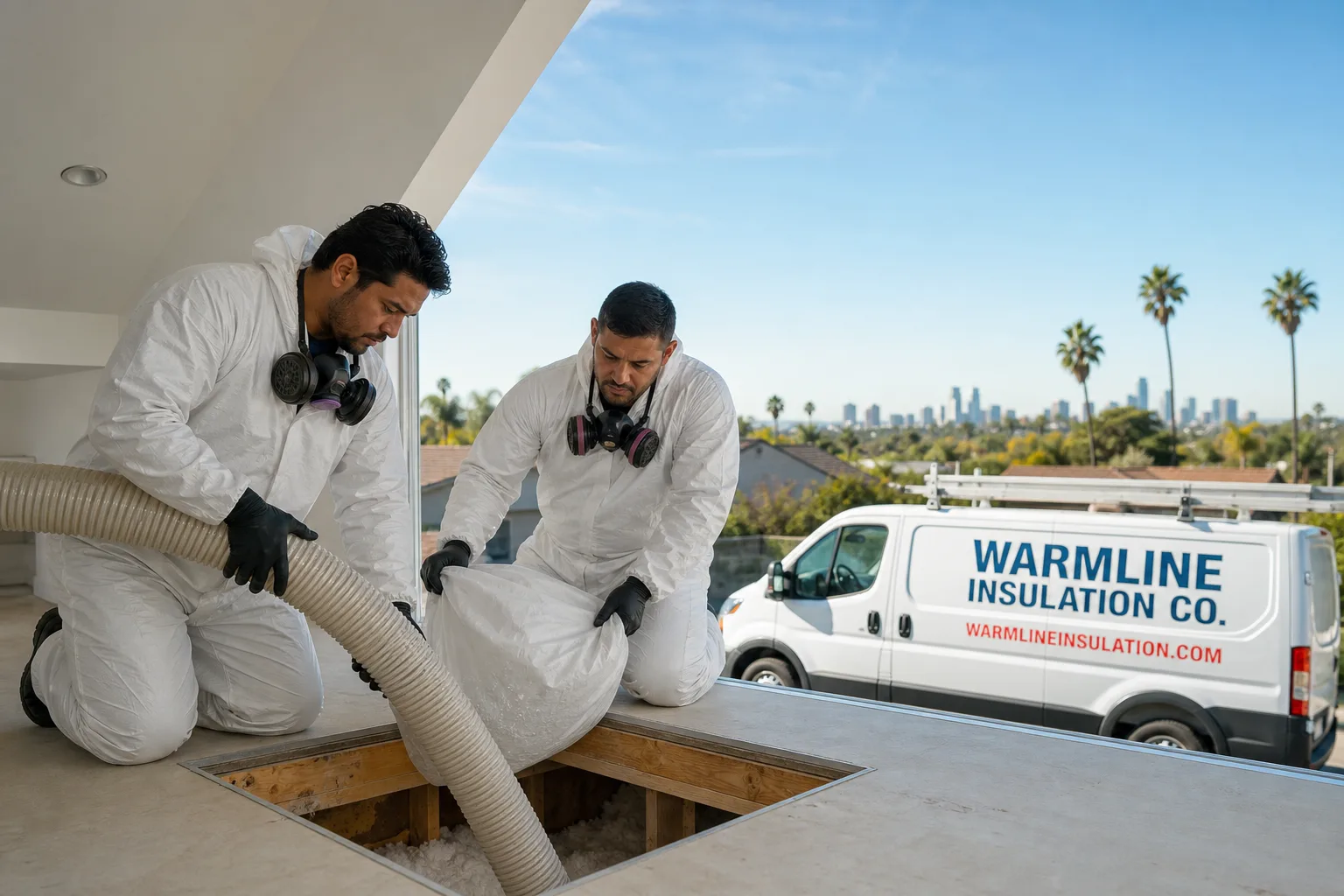
How Much Does Wall Insulation Cost in Los Angeles?
Our Wall Insulation services in Los Angeles typically cost between $1.50 and $4.50 per square foot, with most homeowners spending $1,800 to $6,500 for a full-house project. The exact number depends on your home’s size, the insulation type you choose, and whether your walls are open (new construction or gut renovation) or closed (existing drywall stays in place). Most jobs we complete in Los Angeles are done in a single visit, and we provide upfront pricing before any work begins.
Wall Insulation Cost Breakdown (2026)
The table below reflects real pricing in the Los Angeles market as of 2026, including labor. These are not national averages – they account for local labor rates, Southern California material shipping costs, and the specific wall construction styles common in LA homes, from 1920s craftsman bungalows in Silver Lake to 1980s stucco ranchers in the San Fernando Valley.
| Insulation Type | Method | Cost per Sq Ft (installed) | Typical Whole-House Range |
|---|---|---|---|
| Blown-In Fiberglass or Cellulose | Retrofit (closed wall) | $2.00 – $3.25 | $2,200 – $5,500 |
| Fiberglass Batt (Owens Corning, Johns Manville) | Open wall (new or renovation) | $1.50 – $2.50 | $1,800 – $4,200 |
| Mineral Wool / Rockwool Batt | Open wall | $2.25 – $3.50 | $2,800 – $5,800 |
| Dense-Pack Cellulose (GreenFiber) | Retrofit (closed wall) | $2.25 – $3.75 | $2,500 – $6,000 |
| Closed-Cell Spray Foam (Icynene, Demilec) | Open wall or cavity injection | $3.50 – $5.50 | $4,500 – $9,500 |
| Open-Cell Spray Foam (Icynene) | Open wall | $2.50 – $4.00 | $3,000 – $7,000 |
| Rigid Foam Board (exterior continuous) | Exterior application | $3.00 – $5.00 | $4,000 – $9,000 |
A note on these numbers
The ranges above cover the middle 80% of Los Angeles projects. Your home could come in lower if it’s compact and has good wall access, or higher if it’s a multi-story, has irregular framing, or needs old insulation removed first. Removal and disposal typically adds $0.50 to $1.25 per square foot on top of installation. A quick estimate call to (855) 657-3403 will get you a tighter number – no cost, no obligation.
One thing we see often in Los Angeles: older homes in neighborhoods like Echo Park, Highland Park, and Boyle Heights were built before insulation was standard, which means their walls are completely empty. Retrofitting those with blown-in cellulose or dense-pack fiberglass is one of the most impactful upgrades a homeowner can make – and the energy savings in a city with year-round air conditioning use can bring a real payback within a few years.
What Affects Wall Insulation Pricing in Los Angeles
No two homes price out the same way. Here are the six factors that move the number most significantly in the LA market:
- Open vs. closed walls: If your drywall is already up, we use a retrofit method – drilling small holes, blowing in material, and patching. It’s cleaner than a gut job, but it costs more per square foot than simply stapling batts into open studs during a renovation. In Los Angeles, the majority of wall insulation jobs are retrofits because most of the housing stock was built before 1980.
- Wall depth and framing type: Standard 2×4 framing (common in homes built before the 1990s in areas like Pasadena and Glendale) holds less insulation volume than 2×6 framing. Thicker walls allow for higher R-values and affect material quantity. Some older LA homes also have non-standard stud spacing, which requires more labor.
- Home size and linear wall footage: Straightforward but worth stating plainly – a 1,200-square-foot home in Mar Vista will cost significantly less than a 3,000-square-foot home in Encino. We measure total wall surface area, not just square footage of living space, because it’s the walls themselves we’re filling.
- Existing insulation or debris: Many older LA homes have crumbling, rodent-damaged, or simply absent insulation inside their walls. If what’s there needs to come out before we can put new material in, that removal and disposal step adds cost. We’ll tell you exactly what we find and what it means for your quote.
- Access and job complexity: Walls adjacent to finished garages, second-story exterior walls, or areas blocked by built-in cabinetry take longer. In hillside homes common to areas like Silverlake, Los Feliz, and the Hollywood Hills, irregular architecture can add meaningful labor time.
- Insulation material selected: This is often the biggest variable. Fiberglass batts cost the least upfront. Spray foam costs the most, but it also air-seals as it insulates – a meaningful benefit in Los Angeles where dust infiltration and HVAC efficiency go hand in hand. Rockwool sits in the middle and adds fire resistance, which some homeowners in higher fire-risk areas of LA prioritize specifically.
Los Angeles-Specific Factors That Change the Math
Los Angeles has a building environment that’s genuinely different from other major markets, and those differences affect wall insulation decisions in specific ways.
Climate zone and R-value requirements
Los Angeles sits primarily in California Climate Zone 9 (inland valleys like the San Gabriel Valley, Pomona, and the eastern San Fernando Valley) and Climate Zone 6 (coastal areas including Santa Monica, El Segundo, and most of the Westside). The California Energy Code sets minimum R-values for walls at R-13 for 2×4 framing and R-20 or R-13+5 for 2×6 framing. These are minimums – not targets. Homes in hotter inland zones like Northridge or Chatsworth benefit substantially from exceeding the minimum, especially given summer cooling loads.
Fire risk and material selection
For homes in Very High Fire Hazard Severity Zones – portions of the Santa Monica Mountains, Topanga Canyon, and foothill communities like Altadena and La Canada Flintridge – material choice carries additional weight. Rockwool (mineral wool) is inherently non-combustible and carries a Class A fire rating, which is why we see increased demand for it in these areas. It costs a bit more than fiberglass batts, but it’s the right material for homes in those corridors.
Older housing stock and air sealing overlap
A significant portion of Los Angeles’s single-family housing stock dates from the 1920s through the 1960s, particularly in neighborhoods like West Adams, Leimert Park, and Culver City. These homes typically have no wall insulation at all, and their framing contains gaps and penetrations that let conditioned air leak out constantly. When we do wall insulation in these homes, we almost always pair it with targeted air sealing – it’s the combination that produces real energy savings, not insulation alone. That pairing does add to project cost, but the outcome is a fundamentally different home.
Permit requirements
The City of Los Angeles and most surrounding municipalities do not require a permit for blown-in wall insulation retrofits in existing homes. Spray foam applied to exterior sheeting or as part of a re-roof or re-side project may trigger a permit depending on scope. We’ll confirm permit requirements for your specific project and address – that’s part of our upfront process, not an afterthought.
How to Save on Wall Insulation in Los Angeles
Wall insulation is a durable investment – done right, it outlasts most other home improvements. But there are real ways to reduce what you spend upfront without cutting corners on outcome.
Bundle with related work
If you’re already planning a drywall renovation, a siding replacement, or attic insulation work, combining wall insulation into the same mobilization cuts labor cost meaningfully. We handle attic insulation, wall insulation, air sealing, and spray foam under one roof – which means one crew, one visit, one upfront price. Homeowners in Studio City and Sherman Oaks who’ve paired attic and wall work with us have seen their HVAC runtimes drop noticeably the first summer after the job.
Use California utility rebates and tax incentives
LADWP and SoCalGas both offer rebates for qualifying insulation upgrades, and the federal Inflation Reduction Act’s 25C tax credit covers 30% of insulation material costs (up to $1,200 per year) for projects that meet energy efficiency criteria. These programs have specific documentation requirements – we can walk you through what’s needed at the time of your estimate. The combination of a utility rebate and a federal credit can reduce your net cost by several hundred dollars on a mid-size project.
Start with a home energy audit
Before spending anything on wall insulation, a home energy audit tells you exactly where your home is losing energy and which improvements deliver the best return. We offer energy audits as a standalone service. Audit findings frequently reveal that a homeowner who planned to insulate every wall can achieve nearly the same outcome by targeting two or three key areas – which changes the budget significantly. It’s the diagnostic step that makes every other service smarter.
Take advantage of our standing discounts
Warmline Insulation Co. offers $50 off any repair over $250, an $89 Seasonal Tune-Up, and a permanent 5% discount for seniors and veterans – no hoops, no expiration. If you qualify for the senior or veteran discount, mention it when you call. Our live-person phone team answers 24/7 at (855) 657-3403, and estimates are always free.
Don’t over-specify the material for your situation
Spray foam is exceptional in the right applications, but for a straightforward closed-wall retrofit in a 1960s stucco home in the Valley, dense-pack cellulose or blown-in fiberglass often achieves the same energy outcome at 40-50% lower material cost. We’ll tell you honestly which product fits your situation, not which one has the highest margin. That’s what backing our work with a written 90-Day Done Right Promise actually means in practice.
DIY vs. Professional Wall Insulation in Los Angeles
Blown-in and spray foam insulation are not realistic DIY projects for most homeowners. Blown-in retrofit work requires a blowing machine, proper hole placement and sizing, and the skill to verify fill density – underfill is invisible but leaves cold spots and performance gaps. Spray foam chemistry is unforgiving: incorrect mixing ratios or application thickness create permanent performance problems that can only be remedied by tearing out and starting over.
Open-wall batt installation during a renovation is the one scenario where a capable DIYer can reasonably handle the material work. Even then, the air sealing step – foam-gunning all penetrations, wire runs, and top and bottom plates before the batts go in – is where most DIY installations fall short. That air sealing step is often responsible for 30-40% of the total thermal benefit. Skipping it or doing it poorly means leaving a significant portion of the project’s value on the table.
Our view: get the estimate first. You may find the professional cost is closer to the DIY cost than you expected, with the guarantee and the result to match.
How Long Does Wall Insulation Last in Los Angeles?
Properly installed wall insulation in Los Angeles homes has a long service life. Fiberglass and mineral wool batts are rated to last 80-100 years and are inert – they don’t degrade, absorb moisture, or compact significantly in a properly detailed wall assembly. Cellulose can settle modestly over time, which is why dense-pack installation (at higher density) is preferred for retrofit work. Spray foam, once cured, is essentially permanent.
What degrades insulation performance in Los Angeles walls isn’t usually the material itself – it’s rodent activity. In neighborhoods near the foothills like Sunland-Tujunga, Granada Hills, and Sylmar, we routinely find wall insulation that’s been used as nesting material by rats or mice. If that’s happened in your home, the insulation needs to come out before new material goes in. We handle removal, sanitation, and reinstallation as a single process – no need to coordinate multiple contractors.
Signs Your Los Angeles Home Needs Wall Insulation
- Rooms that never cool properly in summer despite a functioning AC system – common in west-facing rooms across the San Fernando Valley where afternoon sun loads are intense
- High electric bills relative to similar homes in your neighborhood
- Walls that feel warm to the touch on hot days or cold on winter mornings
- A home energy audit that shows wall heat loss as a primary energy drain
- A house built before 1978, when insulation was not yet standard in California residential construction
- Visible pest activity or a previous rodent remediation that didn’t include insulation replacement
- Noise intrusion from outside – wall insulation, especially Rockwool, meaningfully reduces sound transmission from street noise, neighbors, and freeway proximity
FAQs – Wall Insulation Cost in Los Angeles
How much does blown-in wall insulation cost in Los Angeles?
Blown-in wall insulation in Los Angeles costs $2.00 to $3.25 per square foot installed, putting a typical single-story home in the $2,200 to $5,000 range. The main variables are wall surface area, access conditions, and whether old insulation needs to come out first. This is the most common method for existing LA homes where the drywall stays in place. Call (855) 657-3403 for a free estimate specific to your home’s layout.
Is wall insulation worth it in Los Angeles given the mild climate?
Yes – and it’s often underestimated precisely because people assume mild weather means low energy loads. Cooling is the primary driver in Los Angeles, not heating, and walls with no insulation allow afternoon heat to radiate into living spaces for hours after the sun sets. Homes in the inland Valley, the 210 corridor, and south-facing properties throughout LA County see meaningful HVAC savings after wall insulation. The 25C federal tax credit (30% of material cost, up to $1,200) also significantly improves the return on investment calculation.
Can you insulate walls without removing drywall in Los Angeles?
Yes. Retrofit blown-in installation is specifically designed for this. Small holes are drilled in the wall surface (interior drywall or exterior stucco), material is blown into the cavity under controlled pressure, and the holes are patched and finished. Most homeowners can’t tell the work was done once it’s complete. This is the standard approach for Los Angeles homes built before the 1990s that have never had wall insulation added.
How long does wall insulation installation take in Los Angeles?
Most wall insulation projects in Los Angeles are completed in a single day. A 1,500-square-foot home typically takes four to six hours for the installation itself. Patch drying time adds a day before painting. Spray foam projects in open-wall conditions can take less time for application but require off-gassing ventilation before the home is fully occupied – we’ll give you a specific timeline at the estimate stage.
Does wall insulation reduce noise as well as heat in Los Angeles?
It does, and this is a meaningful benefit in Los Angeles specifically. Mineral wool (Rockwool) offers the best sound absorption of any common wall insulation material – its density and fibrous structure absorbs sound energy rather than just slowing heat transfer. For homes near the 101, 405, or 110 freeways, or on busy surface streets in neighborhoods like Koreatown or Palms, Rockwool batts or dense-pack cellulose in party walls can make a noticeable difference in ambient noise levels. Dense-pack cellulose also performs well acoustically.
What insulation material is best for Los Angeles homes?
For most closed-wall retrofits in Los Angeles, dense-pack cellulose or blown-in fiberglass is the practical choice – good thermal performance, reasonable cost, and minimal disruption to existing finishes. For open-wall renovations, Rockwool batts are worth the modest premium for their fire resistance (especially relevant near fire hazard zones) and sound blocking. Spray foam (Icynene or Demilec) is the right call when you need a simultaneous air barrier and insulation layer in a single product, or when dealing with complex geometries. We’ll tell you which fits your specific home – not which one we prefer selling.
Why Warmline Insulation Co. for Wall Insulation in Los Angeles
Neil Ashford founded Warmline Insulation Co. in 2011 with a specific premise: insulation should be treated as a building-science discipline, not an afterthought stapled in before drywall goes up. Fifteen years later, that’s still how we operate across Los Angeles and the surrounding communities we serve.
Our wall insulation work uses materials from Owens Corning, Rockwool, CertainTeed, GreenFiber, Icynene, Demilec, Johns Manville, and Knauf – the benchmark brands in the industry – because the material quality directly affects how long your results last. Every technician we send is background-checked and uniformed. Every price we quote is the price you pay. And every wall insulation job we complete is backed by our written 90-Day Done Right Promise: if it’s not right, we make it right, no debate.
We also handle everything insulation-related under one roof. If your wall project reveals attic air bypass issues, rodent damage, or crawl space moisture problems, you don’t have to call three other contractors. From our Wall Insulation in Los Angeles service to full home energy audits, we manage the whole scope.
If you want to know more about our full range of home performance services, you can start at our home page, which covers everything we offer.
Key Takeaways
- Wall insulation in Los Angeles costs $1.50 to $4.50 per square foot installed, with whole-house projects typically running $1,800 to $6,500 depending on type and method.
- Blown-in retrofit is the most common method for existing LA homes and doesn’t require removing drywall.
- Spray foam costs more upfront but adds air sealing simultaneously – often the right call for older homes with significant infiltration.
- The federal 25C tax credit (30%, up to $1,200) and LADWP/SoCalGas rebates can reduce net project cost meaningfully.
- Older homes in neighborhoods like Echo Park, West Adams, and Highland Park are frequently uninsulated entirely – retrofitting these produces substantial energy and comfort improvements.
- Rockwool is worth the premium for homes in fire-hazard zones and freeway-adjacent properties where noise is a concern.
- A home energy audit before committing to a full wall project helps you spend where it matters most.
- Warmline’s 90-Day Done Right Promise, upfront pricing, and live 24/7 phone line mean no surprises at any stage.
Get Your Free Wall Insulation Estimate in Los Angeles
If your Los Angeles home has rooms that won’t stay cool, energy bills that don’t match your usage, or walls you suspect have never been insulated, the next step is a straightforward conversation. Neil Ashford and the Warmline team have been diagnosing and fixing exactly these situations since 2011, and a free estimate costs you nothing but a phone call.
Call (855) 657-3403 – a live person answers 24/7, not a voicemail. We’ll ask a few questions about your home, schedule a time that works for you, and give you a clear, upfront price before any work begins. Most projects are completed in a single visit. Seniors and veterans receive a permanent 5% discount, and any qualifying repair over $250 is eligible for $50 off.
Wall insulation in Los Angeles is one of the highest-return home improvements available in this climate. Done right, it changes how your home feels every single day. We back that with our 90-Day Done Right Promise – in writing.
Written by Neil Ashford, Owner at Warmline Insulation Co., serving Los Angeles since 2011.
Pricing reflects the Los Angeles market as of 2026. Warmline Insulation Co. offers free estimates – call (855) 657-3403.
What Our Customers Say
"The estimate had every line itemized - removal, sealing, baffles, the blown-in by the bag - and the final invoice matched it exactly. Two other companies quoted a single number and could not tell me what R-value they were installing."
- Priya Raman"Radiant barrier stapled to the rafters plus new baffles at the soffits. Attic temperature dropped enough that the AC runs noticeably less in the afternoon. Crew was in and out in a day and left the garage cleaner than they found it."
- Sam Kessler"Injection foam in the walls of our 1950s house - no drywall demolition, just small holes patched and painted the same day. The street noise in the front bedroom is half what it was."
- Yasmin Farah